Demand Forecasting in Supply Chain: Methods, Tools & Best Practices (2026)
Demand forecasting in supply chain is essential for inventory planning. Learn the best methods, tools, and practices for accurate supply chain forecasting on Shopify.
Hylke Reitsma is co-founder of Forthsuite and a supply chain specialist with 8+ years of hands-on experience at Shell, Verisure, and Stryker. He holds an MSc in Supply Chain Management from the University of Groningen and writes practical guides to help e-commerce teams run leaner, faster supply chains. Selected by Replit as 1 of 20 founders for the inaugural Race to Revenue Cohort #1 (2026) and certified as a Replit Platform Builder.
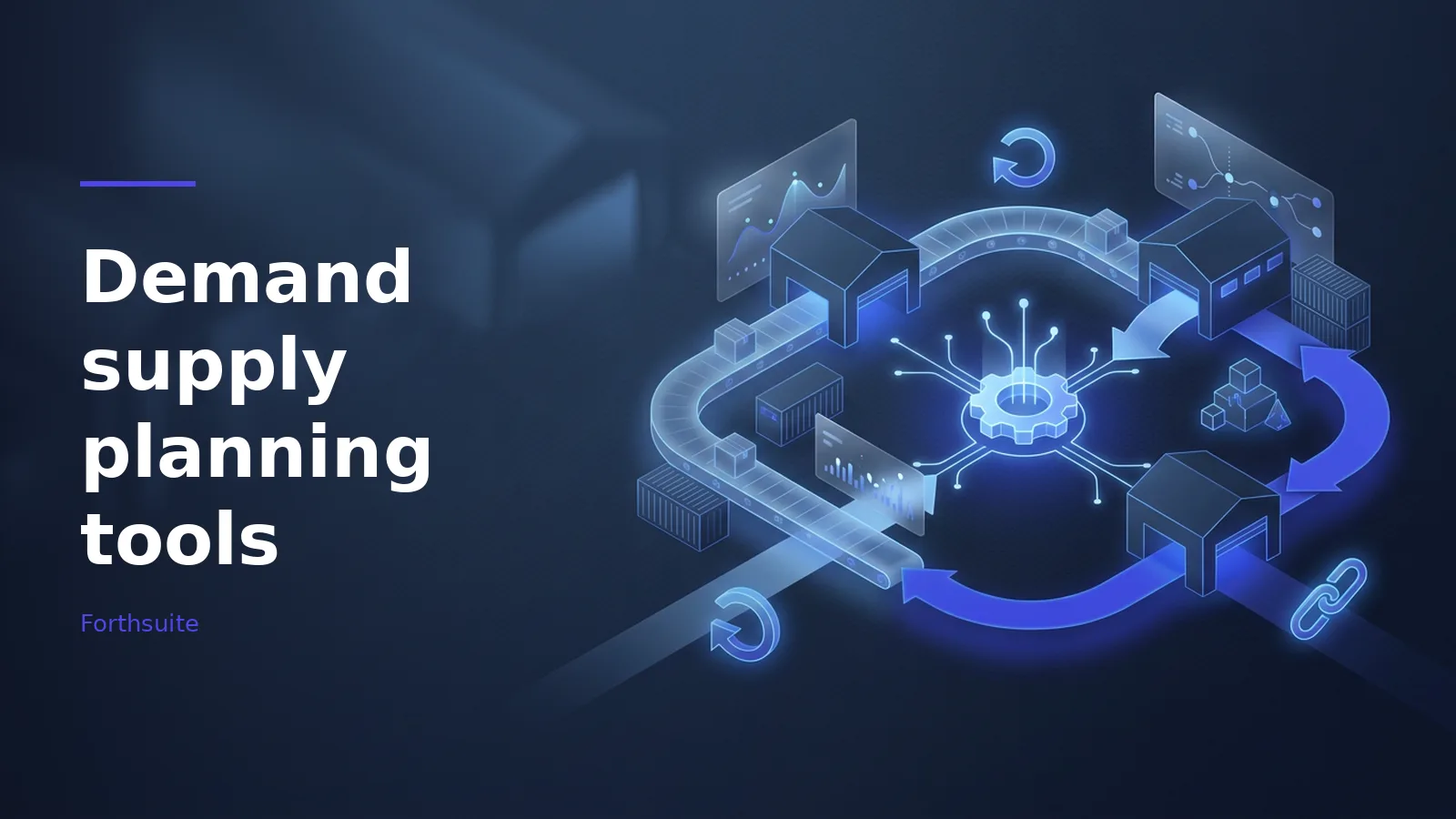
Demand forecasting in supply chain is the practice of predicting future product demand to drive smarter procurement, manufacturing, and inventory decisions — connecting what customers will buy to how much stock to hold, when to reorder, and how to position inventory across your supply network. Forthsuite's supply chain OS automates this process for Shopify merchants by ingesting real-time sales data and generating statistically optimized forecasts that reduce excess inventory while preventing stockouts.
Why Demand Forecasting Is Critical in Supply Chain Management
The stakes of poor demand forecasting are measurable and severe. Excess inventory costs global retailers $1.1 trillion in carrying costs annually, while stockouts cost $1 trillion in lost sales (IHL Group, 2023). For Shopify merchants, this dual risk translates directly to working capital trapped in warehouses or revenue hemorrhaged through unfulfilled orders.
Demand forecasting eliminates guesswork from three core supply chain decisions:
- Procurement Planning: How many units to purchase from suppliers at what intervals
- Inventory Positioning: Where to stage stock across fulfillment centers or supplier warehouses
- Manufacturing Schedules: Production quantities and timing for brands making their own products
According to a 2024 Gartner survey, companies with advanced forecasting capabilities achieve 15% lower inventory holding costs and 20% improvement in order fulfillment rates. The ROI compounds across the supply chain: accurate forecasts reduce cash flow strain, lower warehouse rent, minimize shrinkage and spoilage, and free capital for growth initiatives.
The pandemic reinforced why static, historical forecasting fails. Demand volatility increased 30-40% between 2019 and 2023 across most retail categories (McKinsey, 2024). Traditional methods that rely on moving averages of past sales cannot capture demand shifts caused by viral trends, competitive launches, supply disruptions, or macroeconomic changes. Modern demand forecasting must adapt in real time.
Demand Forecasting Methods in Supply Chain
Supply chain professionals can choose from six primary forecasting methodologies, each with distinct strengths and application windows. The optimal approach depends on data richness, forecast horizon, and product lifecycle stage.
1. Moving Averages (Simple & Weighted)
How it works: Calculates the average of sales over a fixed period (e.g., last 12 weeks) to predict the next period. Weighted moving averages assign higher importance to recent periods.
Best for: Stable, mature SKUs with consistent demand patterns. Fast-moving consumer goods. Forecasts of 4-12 weeks out.
Pros: Simple to implement. Minimal data requirements. Low computational cost. Easy to audit.
Cons: Responds slowly to demand shifts. Cannot capture seasonality or trends. Assumes past patterns continue unchanged.
2. Exponential Smoothing
How it works: Weights recent observations more heavily than older ones using a smoothing factor (alpha). Variants include Holt's method (for trends) and Holt-Winters (for seasonality).
Best for: Products with trend or seasonal components. Mid-range forecasts (8-16 weeks). SKUs with moderate data history.
Pros: Adapts faster to demand changes than moving averages. Handles trends and seasonality naturally. Still interpretable.
Cons: Requires parameter tuning (alpha, beta, gamma values). Less accurate with irregular demand patterns. Cannot detect external drivers of change.
3. Regression Analysis
How it works: Models demand as a linear or nonlinear function of predictor variables (price, marketing spend, day-of-week, competitor activity).
Best for: Products with clear causal relationships between marketing or pricing and demand. High-SKU environments where patterns need to be standardized.
Pros: Captures the "why" behind demand. Enables what-if scenario modeling. Works well with promotional calendars.
Cons: Requires detailed input data (prices, marketing, external signals). Multicollinearity can distort results. Assumes relationships remain stable.
4. Machine Learning Models (Neural Networks, Random Forests, Gradient Boosting)
How it works: Algorithms detect nonlinear patterns across hundreds of features (historical sales, weather, social sentiment, inventory levels, competitor pricing) without explicit programming.
Best for: Large product catalogs with complex demand drivers. Fast-moving or volatile categories. Forecasts requiring real-time adaptation.
Pros: Highest accuracy potential on large datasets. Handles nonlinear relationships and interactions. Improves with more data over time. Can detect novel patterns humans miss.
Cons: Requires significant historical data (typically 24+ months). Computationally expensive. "Black box" — harder to explain why forecast changed. Prone to overfitting.
5. Collaborative Forecasting (CPFR)
How it works: Combines forecast inputs from multiple stakeholders: retail sales teams (who know customer behavior), suppliers (who see order patterns), and manufacturers (who understand production constraints). Forecasts are iteratively refined through shared processes.
Best for: Supply chains with strong supplier relationships. Products with long lead times. Categories where order visibility across tiers prevents bullwhip effect.
Pros: Incorporates ground-truth insights from multiple perspectives. Reduces forecast bias. Aligns supply and demand planning across organizations.
Cons: Requires operational integration and trust between partners. Slower process. Coordination costs. Difficult to implement across fragmented supplier networks.
6. Demand Sensing / Short-Horizon Forecasting
How it works: Uses recent POS data, inventory levels, and real-time demand signals (website traffic, search trends, social media mentions) to forecast the next 1-4 weeks with high precision.
Best for: Perishable goods. Fashion and seasonal items with compressed selling windows. Last-mile inventory allocation.
Pros: Captures demand shifts within days. Uses most current information. Reduces obsolescence risk.
Cons: Poor for medium- to long-term planning. Requires constant data streams. Cannot predict unprecedented events.
Comparative Methods Table
| Method | Forecast Horizon | Data Required | Accuracy (Mature SKU) | Implementation Complexity | Cost |
|---|---|---|---|---|---|
| Moving Average | 4-12 weeks | Historical sales | 70-75% | Low | Free (Excel) |
| Exponential Smoothing | 8-16 weeks | Historical sales + seasonality | 75-82% | Low-Medium | $2-5K/year |
| Regression | 6-24 weeks | Sales + drivers (price, marketing, weather) | 78-85% | Medium | $5-15K/year |
| Machine Learning | 1-52 weeks | 24+ months historical + rich features | 82-92% | High | $50K-500K+/year |
| Collaborative (CPFR) | 2-16 weeks | Multi-tier sales + constraints | 80-90% | High | Integration-dependent |
| Demand Sensing | 1-4 weeks | Real-time POS + external signals | 85-95% | Medium-High | $30-150K/year |
Supply Chain Forecasting vs. Demand Sensing: Complementary, Not Competing
Supply chain forecasting and demand sensing operate across different time horizons and serve different operational purposes. Understanding the distinction prevents budget waste and tactical confusion.
Supply Chain Forecasting addresses medium- to long-term planning (6 weeks to 24 months). It answers: "How much inventory do we need to procure this quarter?" or "What production schedules should we lock in with our manufacturer?" Forecasting is built on statistical methods applied to historical patterns and uses supplier lead times as a key constraint. Accuracy of ±15-25% is typically acceptable because the forecast informs bulk decisions (purchase orders, production runs) where absolute precision is less critical than directional accuracy.
Demand Sensing handles the last mile of inventory optimization (1-4 weeks out). It answers: "Which fulfillment center should receive this week's shipment?" or "Do we need emergency air freight?" Demand sensing relies on real-time signals: POS transactions, website traffic spikes, live inventory levels, and short-term promotional activity. Accuracy requirements are tighter (±5-10%) because sensing directs tactical decisions like same-week replenishment or dynamic pricing.
The two methods reinforce each other. A supply chain forecast tells your supplier "expect 10,000 units next quarter." Demand sensing tells your warehouse "prioritize 2,000 units to Region B this week." Without both, you either order blindly (forecasting alone) or run out of inventory (sensing alone with no upstream procurement visibility).
Forthsuite integrates both approaches. The platform generates 8-16 week supply chain forecasts for procurement decisions while simultaneously running demand sensing algorithms on your Shopify POS data to flag imminent reorder triggers.
Key Inputs for Accurate Supply Chain Demand Forecasting
Forecast accuracy is bounded by input quality. Garbage in equals garbage out. Supply chain professionals must audit five data sources before deploying any forecasting method.
1. Historical Sales Data (Transactional-Level)
The foundation of all forecasting. Demand forecasting requires granular transaction history: daily or weekly sales per SKU, ideally spanning 24+ months. For Shopify merchants, this includes order dates, quantities, and product variants.
Common pitfalls: Sales data corrupted by system migrations, missing transactions during platform downtime, or bundled SKUs conflating individual demand. Audit your data source (Shopify admin, export logs, database backups) to ensure continuity.
2. Point-of-Sale (POS) Data
For multi-channel retailers, POS data from in-store systems, online checkouts, and mobile apps must be consolidated. POS data reveals demand patterns that invoicing data (what you shipped) cannot capture because it includes abandoned carts and returns.
Implementation tip: Separate POS data by channel and customer segment. Online demand often leads offline demand for fashion; the inverse is true for grocery. Channel-specific forecasts reduce error.
3. Promotional Calendar and Campaign Data
Demand spikes around promotions, holidays, and marketing campaigns. Without promotional calendars, forecasts cannot distinguish a real demand increase from a sale-driven spike.
What to track:
- Discount level and duration (% off or fixed price)
- Marketing channel (email, social, paid search)
- Launch date and audience size
- Competing promotions in your market
Regression and machine learning models use promotional flags as feature inputs. When the forecast sees "Father's Day sale, 30% off, email to 500K subscribers," it correctly attributes the demand lift to promotion rather than treating it as baseline trend.
4. Seasonality Indexes and External Calendar Events
Certain products are inherently seasonal: Halloween costumes, tax software, sunscreen. Some seasons are cultural (Lunar New Year, Ramadan) and region-specific.
How to capture seasonality: Calculate a seasonality index (actual sales ÷ average sales) for each month or week over your historical period. Week 50 (pre-Christmas) might have an index of 2.5, meaning sales are 2.5× baseline. This index is then applied to baseline forecasts for future years.
External calendar events to flag: holidays, industry trade shows, school calendar dates (for back-to-school retail), tax filing deadlines, and weather-driven seasons (e.g., storms correlating with flashlight demand).
5. External Market Signals
Macro and micro signals outside your transaction history improve forecast resilience.
Macro signals: GDP growth, unemployment rates, consumer confidence indices, currency exchange rates (for importers). These capture economic headwinds or tailwinds affecting discretionary spending.
Micro signals: Competitor pricing and stock levels, influencer mentions, trending search terms (Google Trends, TikTok, Reddit), social media sentiment, news about supply disruptions (e.g., port strikes affecting lead times), weather forecasts, and inventory levels at suppliers.
A handbag retailer's forecast might incorporate: trending colors on Pinterest, influencer collaborations, competitor stockouts (signaling category demand), and macro signals like fashion week announcements. Machine learning models automatically weight which signals correlate with demand in your category.
Data integration architecture: The best forecasting systems ingest data continuously. Forthsuite pulls Shopify transaction data hourly, allowing forecasts to adapt to demand shifts within days rather than weeks. This real-time refresh is critical in volatile categories like beauty or electronics.
Demand Forecasting Best Practices for Shopify Merchants
Shopify merchants operate with constraints distinct from enterprise retailers: smaller teams, lower IT budgets, rapid SKU proliferation, and multi-channel operations (Shopify + Amazon + social commerce). These seven practices are tailored to these realities.
Practice 1: Segment Forecasts by Product Lifecycle Stage
Demand forecasting accuracy varies wildly across product lifecycle stages. Treat new products, growth products, mature products, and declining products with different methods.
New Products (0-3 months): Historical data is sparse, so forecasts rely on comparable product analogs and qualitative judgment. A new coffee roast is forecast using data from your existing coffee products adjusted for marketing spend. Accuracy expectations: ±40-50%.
Growth Products (3-12 months): Data is accumulating, but growth trends may be nonlinear (viral adoption). Use exponential smoothing with trend components or lightweight machine learning. Reforecast weekly. Accuracy expectations: ±20-30%.
Mature Products (12+ months): Stable patterns and rich historical data. All methods work; use regression or machine learning for best results. Reforecast monthly. Accuracy expectations: ±10-15%.
Declining Products: Do not forecast. Phase out systematically based on inventory levels and customer requests. Overforecasting creates excess stock.
Implementation in Forthsuite: Tag each SKU with lifecycle stage in your product feed. The system automatically applies appropriate methods.
Practice 2: Track and Measure Forecast Error Continuously
Forecasting is not a set-it-and-forget-it activity. You must measure forecast accuracy weekly and investigate deviations.
Key metrics:
- Mean Absolute Percentage Error (MAPE): Average of |forecast - actual| ÷ actual, expressed as %. Target: <15% for mature SKUs, <25% for newer products.
- Bias: Are you consistently over- or under-forecasting? Positive bias (forecasting too high) inflates inventory; negative bias (forecasting too low) causes stockouts. Target: Within ±5%.
- Forecast vs. Actual by Week: Charts showing forecast lines against actual sales reveal systematic errors (e.g., every Friday is 20% higher than predicted).
Action triggers: If MAPE exceeds 20% for a mature SKU for two weeks running, investigate: Did a competitor launch? Did a promotional campaign underperform? Was there supply news (delay, price increase) that discouraged customers? Update your forecast inputs accordingly.
Practice 3: Separate Demand from Supply Constraints
Historical sales data reflects what you sold, not what customers wanted to buy. If a popular SKU was frequently out of stock, your historical sales understate true demand.
How to adjust: Flag out-of-stock periods in your historical data. When forecasting, either exclude out-of-stock periods or apply a demand recovery factor. If your records show you sold 100 units of a product but were out of stock for 20% of the period, estimate true demand at ~125 units.
Supplier constraints similarly distort history: If you ordered only 500 units because your supplier had a 500-unit minimum but customer demand was clearly higher, future forecasts should reflect unconstrained demand.
Practice 4: Incorporate Promotional and Seasonal Calendars From Day One
Delays in logging promotional calendars undermine forecast accuracy. At the start of each month, supply your forecasting system with all promotional plans for the next 90 days: launch dates, discount levels, channels, and target audiences.
Seasonal calendar example (e-commerce apparel):
- January: New Year, resolution-driven activewear demand (seasonality index: 1.8)
- March-April: Spring/Easter, pastels, garden themes (index: 1.5)
- July-August: Back-to-school (index: 2.0, peaks week of Labor Day)
- October: Halloween, costume demand spikes (index: 3.0)
- November: Black Friday/Cyber Monday prep (index: 2.5)
- December: Holiday gifting (index: 3.5, peaks Dec. 15-20)
Without these inputs, the forecast will underestimate summer and holiday demand, leading to stockouts and lost revenue.
Practice 5: Establish Reorder Points (ROP) and Safety Stock Thresholds Based on Forecast Confidence
The forecast is not a fixed number — it is a probability distribution. A forecast of 1,000 units might actually mean: 80% confidence the demand falls between 800-1,200 units.
Using forecast confidence to set safety stock:
- If you want 95% service level (stock out no more than 5% of the time), set safety stock at the 95th percentile of the forecast distribution.
- If MAPE is 15%, a forecast of 1,000 units implies a ~95% confidence range of 850-1,150. Order safety stock to cover the upper range plus lead time demand.
- For high-margin, fast-moving SKUs, target 95-98% service level. For low-margin or slow-moving SKUs, 80-90% is acceptable.
Reorder point formula: ROP = (average daily demand × lead time in days) + safety stock.
Example: If your forecast predicts 100 units/day, supplier lead time is 14 days, and safety stock is 300 units, ROP = (100 × 14) + 300 = 1,700 units. When inventory drops to 1,700, place a new order.
Practice 6: Build Scenarios for Demand Volatility and Supplier Risk
A single point forecast (e.g., "expect 1,000 units next month") is fragile. Build three scenarios: base case (most likely), upside case (20% higher demand), and downside case (20% lower demand).
Upside scenario triggers: Viral social media mention, competitor stockout, favorable press coverage, unexpected influencer partnership.
Downside scenario triggers: Economic slowdown signal, competitive product launch, supplier delay (forcing you to hold safety stock longer), or seasonal demand arriving earlier/later than normal.
Inventory strategy by scenario:
- Base case: Order per ROP calculation.
- Upside case: Add 20-30% buffer; negotiate expedited supplier shipping for key SKUs.
- Downside case: Reduce order quantity; negotiate extended payment terms with suppliers to preserve cash.
This approach prevents the whiplash of chasing a single forecast and keeps you adaptable.
Practice 7: Automate Forecast Recomputation and Alert on Exceptions
Manual forecasting is tedious and error-prone at scale. A Shopify merchant with 500+ SKUs cannot manually reforecast each product monthly.
Automation targets:
- Recompute all forecasts weekly, not monthly, to capture demand shifts faster.
- Flag SKUs where forecast accuracy drops below threshold (MAPE > 20%).
- Alert when actual demand vs. forecast diverges by more than 2 standard deviations (likely a real event, not noise).
- Auto-adjust reorder points based on updated forecast variance.
- Generate a weekly "forecast health" dashboard showing: top overstocked SKUs, top understocked SKUs, forecast accuracy trends, and recommended procurement actions.
Forthsuite automates all of these. The platform syncs with Shopify hourly, reforecasts daily, and sends Slack notifications when exceptions occur.
Demand Forecasting Tools for Supply Chain
Supply chain professionals have three tool categories to choose from, each with trade-offs in cost, control, and accuracy.
Spreadsheet-Based Forecasting (Excel, Google Sheets)
How it works: Manual formulas for moving averages, exponential smoothing, or simple regression built into Excel/Sheets. Forecasts are computed and updated by supply chain staff.
Cost: $0-15/month (if using free tools or existing office subscriptions).
Pros:
- Complete control and transparency. You own every formula.
- No vendor lock-in. Easy to export, audit, and modify.
- Fast to prototype for specific use cases.
- Works offline; no dependency on cloud infrastructure.
Cons:
- Does not scale. Manual data entry for 500+ SKUs is impractical.
- No automation. Forecasts go stale between manual updates.
- Cannot handle real-time Shopify data; lag between transaction and forecast is weeks.
- Limited to simple statistical methods. No machine learning, no demand sensing.
- Error-prone: formula mistakes, accidental overwrites, version control chaos across team members.
- Cannot enforce governance; anyone can change the forecast without audit trail.
When to use: Businesses with fewer than 50 SKUs and stable demand. Temporary solution while evaluating full software systems. Side projects or new product experimentation.
Dedicated Demand Forecasting Software (Lokad, Recast, Macuiba)
How it works: Cloud-based platforms built exclusively for demand forecasting. They ingest historical sales data, apply multiple statistical and machine learning algorithms, and output forecasts with confidence intervals. Some integrate with suppliers or ERP systems.
Cost: $500-10,000/month depending on SKU volume and data refresh frequency.
Pros:
- Advanced algorithms including machine learning and demand sensing.
- Automates reforecasting and feeds results to your ERP or inventory system.
- Strong focus on forecast accuracy; these platforms are built for this single problem.
- Multi-method comparison: system applies multiple algorithms and selects the best-fit model per SKU.
- Scenario modeling and what-if analysis built-in.
Cons:
- Siloed from inventory management and procurement. Forecasts are an input to other systems; not integrated into end-to-end supply chain operations.
- Requires data preparation. You must extract, clean, and feed your historical sales data to the platform regularly.
- Limited integration with Shopify. Most were built before e-commerce and require custom API work to connect.
- Does not recommend procurement actions; you must manually translate forecasts into POs.
- Expensive for small merchants (early-stage Shopify stores).
When to use: Mid-market retailers (500-10,000 SKUs) with complex seasonal or promotional patterns. B2B companies selling to retail customers. Businesses where forecast accuracy directly impacts profitability.
Integrated Supply Chain OS (Forthsuite, Kinaxis, Blue Yonder)
How it works: Platform-native supply chain operating systems that embed demand forecasting as one module within a unified system. Forecasts feed directly into inventory management, procurement recommendations, and supplier collaboration.
Cost: $1,000-50,000+/month depending on SKU count, transaction volume, and features.
Forthsuite specifics (native Shopify OS):
- Forecasting is tightly integrated with inventory management and reorder automation.
- Ingests Shopify transaction data hourly; no manual data preparation.
- Applies statistical and machine learning models automatically, selecting best-fit per SKU.
- Generates reorder signals in real time; can auto-trigger POs to suppliers via connected supplier portals.
- Built for e-commerce: understands multi-channel demand, handles product variants and bundles, and adapts to rapid SKU scaling.
- Demand sensing layer optimizes last-mile inventory allocation across fulfillment centers.
- Transparent: you can see which forecast method was selected and why; adjustable confidence thresholds.
Pros of integrated OS approach:
- End-to-end visibility. Forecast connects to actual procurement actions, not a black box.
- No data silos. Real-time feedback loops improve forecasts as actual results come in.
- Addresses root causes of demand forecasting failure: weak data integration, manual handoffs, and organizational silos.
- Scales efficiently. Adding 1,000 SKUs does not increase complexity; the platform handles volume automatically.
- Smaller merchants can afford entry-level tiers; pricing scales with growth.
Cons:
- Vendor lock-in is greater; switching systems is costly.
- Learning curve steeper; team must understand the full platform, not just one module.
- Less flexibility for use-case-specific customization than dedicated forecasting software.
When to use: Shopify merchants of all sizes seeking integrated demand planning and procurement automation. Brands that want forecasting connected to reorder automation, not as an isolated data feed. Companies scaling rapidly and cannot afford manual supply chain management.
Comparative Tool Landscape
| Tool Type | Cost | Best for Forecasting Accuracy | Ease of Data Integration | Speed to Reorder Action | Scalability | Best-Fit Customer |
|---|---|---|---|---|---|---|
| Spreadsheet | Free-$15/mo | Low-Medium | Manual | Slow (manual) | Poor (<50 SKUs) | Early-stage, simple demand |
| Dedicated Forecasting | $500-10K/mo | High | Good (APIs) | Medium (forecast to manual PO) | Good (500-10K SKUs) | Accuracy-focused retailers |
| Supply Chain OS | $1K-50K+/mo | High | Excellent (native) | Fast (automated) | Excellent (unlimited) | Shopify merchants, scaling brands |
How Forthsuite Powers Demand Forecasting Across Your Supply Chain
Forthsuite is a supply chain OS purpose-built for Shopify merchants. Demand forecasting is integrated into the platform's core flow: predict demand → optimize inventory → automate reorders → measure outcomes → improve next forecast.
Automated Data Ingestion from Shopify
Forthsuite connects natively to your Shopify store via the Shopify API. Every transaction is captured hourly:
- Order date, time, and customer location.
- SKU, quantity, and variant (size, color, style).
- Sale price, discounts, and promotional tags.
- Returns and cancellations (demand exceptions).
No manual data export, no CSV uploads, no data pipeline engineering required. The moment a customer buys from your Shopify store, that transaction feeds into Forths
About the Author
Hylke Reitsma is co-founder of Forthsuite and a supply chain specialist with 8+ years of hands-on experience at Shell, Verisure, and Stryker. He holds an MSc in Supply Chain Management from the University of Groningen and writes practical guides to help e-commerce teams run leaner, faster supply chains. Selected by Replit as 1 of 20 founders for the inaugural Race to Revenue Cohort #1 (2026) and certified as a Replit Platform Builder.
LinkedIn