Global Supply Chain Management for Shopify (2026)
Global supply chain management for Shopify can transform your store in 2026 — strategies, tools, and apps. Learn strategies, tools like Forthsuite, and best practices to opt
Hylke Reitsma is co-founder of Forthsuite and a supply chain specialist with 8+ years of hands-on experience at Shell, Verisure, and Stryker. He holds an MSc in Supply Chain Management from the University of Groningen and writes practical guides to help e-commerce teams run leaner, faster supply chains. Selected by Replit as 1 of 20 founders for the inaugural Race to Revenue Cohort #1 (2026) and certified as a Replit Platform Builder.
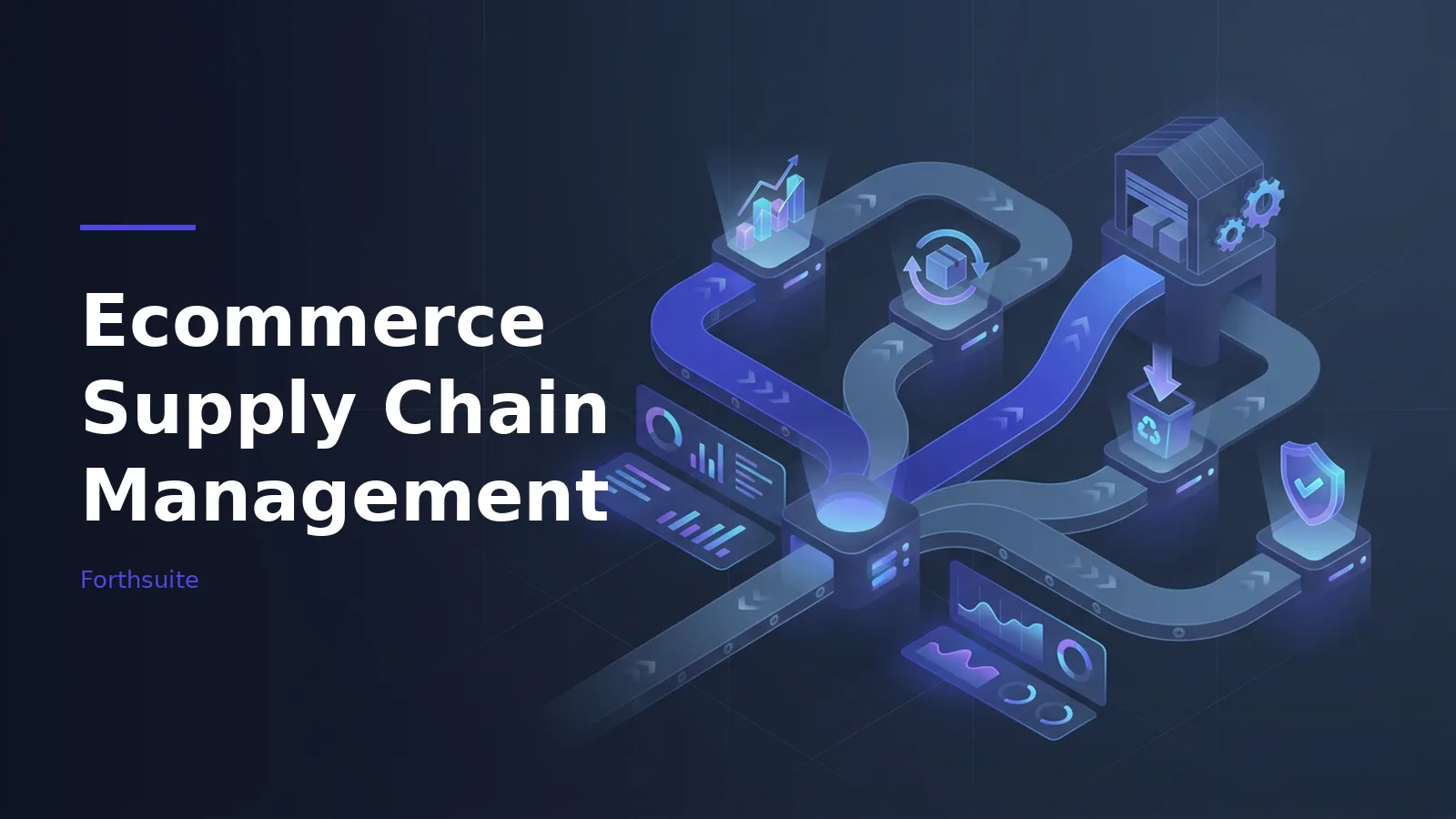
TL;DR: Ecommerce supply chain management is the end-to-end coordination of sourcing, inventory, warehousing, fulfillment, and logistics that gets products from suppliers to customers in an online retail business. Forthsuite helps Shopify merchants streamline their entire supply chain operations by building custom supply-chain systems that draw on five separate apps — Forthcast, Forthroute, Forthmatch, Forthclear, and Forthsource.
Last updated: July 2026
Ecommerce supply chain management is the end-to-end coordination of product flow from suppliers to customers, including procurement, inventory storage, order fulfillment, and returns. For Shopify merchants, effective supply chain management means balancing stock levels to avoid both stockouts and excess inventory, selecting reliable fulfillment partners, and using real-time data to forecast demand and respond to disruptions quickly.
What Is Ecommerce Supply Chain Management?
Supply chain management for online stores encompasses every step between placing a purchase order with a supplier and delivering the product to your customer's doorstep. Unlike traditional retail, ecommerce operations face unique challenges: customers expect 2-3 day shipping, returns rates average 20-30% depending on category, and inventory visibility across multiple warehouses or fulfillment centers is non-negotiable.
The core components include:
- Supplier management: Vetting manufacturers, negotiating terms, and tracking production timelines
- Inventory planning: Determining what to stock, how much, and where to position it
- Warehousing: Storage, organization, and accessibility of products
- Order fulfillment: Picking, packing, and shipping individual orders
- Returns processing: Managing reverse logistics and restocking sellable items
- Transportation: Coordinating freight, parcel carriers, and last-mile delivery
For Shopify merchants scaling past $50,000 monthly revenue, supply chain operations typically represent 15-25% of total costs. Poor management in any one area creates a cascade: stockouts drive customers to competitors, excess inventory ties up cash, slow shipping tanks conversion rates, and inefficient returns processing erodes margins.
The Critical Role of Demand Forecasting in Ecommerce Supply Chain Management
Accurate demand forecasting is the foundation of supply chain efficiency. Traditional methods like "order the same amount as last month" fail to account for seasonality, trend shifts, and marketing campaigns.
Merchants who forecast poorly face a binary outcome: they either run out of bestsellers during peak demand or warehouse dead stock that requires deep discounting.
“owning a 3PL (like an intermediate storage location) in the US based on customer locations to be able to ship fast would be a real competitive advantage. Eg. you can ship in 1-2 days if you know most of your customers are in California”
Modern ecommerce logistics management starts with data. Shopify stores generate rich signals: daily sales velocity, traffic patterns, cart abandonment rates, and customer cohort behavior. The problem is volume. A store with 200 SKUs and 12 months of history has 2,400 data points before accounting for variants, channels, or promotions.
Effective forecasting methods for Shopify merchants include:
- Moving averages: Simple but fails to capture trends or seasonality
- Exponential smoothing: Better for trending products but requires parameter tuning
- Machine learning models: Can process multiple variables (promotions, weather, social trends) simultaneously
Tools like Forthcast apply AI-powered forecasting specifically tuned for Shopify data structures, automatically accounting for stockouts (which suppress demand signals), promotional lifts, and seasonal patterns. Merchants using demand forecasting report reductions in stockout frequency and decreases in excess inventory.
The key metric is forecast accuracy, measured as Mean Absolute Percentage Error (MAPE). A MAPE under 30% is acceptable for fashion or trend-driven categories. For staple products or replenishment items, aim for 15-20% MAPE. Anything consistently above 40% means your forecasting method is worse than guessing.
Selecting and Managing Fulfillment Partners
Once you forecast demand and procure inventory, products need physical homes. Merchants face three primary fulfillment models:
Self-fulfillment: You handle warehousing and shipping. This works when order volume is under 100 daily units, you have warehouse access, and labor costs are manageable. Control is maximum, but scaling requires hiring, space expansion, and systems integration. Most merchants graduate from self-fulfillment between $30,000-75,000 monthly revenue.
Third-party logistics (3PL): Outsourced warehousing and fulfillment. 3PLs charge receiving fees ($30-75 per pallet), storage fees ($8-15 per pallet monthly or $0.40-0.75 per cubic foot), pick and pack fees ($2.50-5.00 per order), and shipping costs. The value proposition is speed and geography. Distributed 3PL networks let you stock inventory closer to customers, reducing shipping time and costs.
Dropshipping: Suppliers ship directly to customers. No inventory risk, but you sacrifice margin (typically 15-30% markup vs 40-60% for stocked products) and control over shipping speed and packaging quality.
Choosing a 3PL requires due diligence beyond price comparison. Ask these questions:
- What is your on-time ship rate? (Target: 98%+)
- What is your order accuracy rate? (Target: 99.5%+)
- How do you handle returns and restocking?
- What technology integrations do you support? (Shopify native is non-negotiable)
- What are your peak season surcharges and capacity limits?
- How quickly can you onboard and receive inventory?
Performance tracking matters. A 3PL might promise 2-day fulfillment but average 3.2 days during Q4. Use tools like Forthmatch to monitor actual fulfillment speed, accuracy rates, and damage claims across partners. Data transparency prevents surprises and gives you leverage during contract negotiations.
Managing Your Shopify Supply Chain Across Multiple Locations
Single-warehouse strategies create geographic bottlenecks. A merchant shipping from California to New York incurs 5-7 day ground transit and $12-18 shipping costs per order.
Split inventory between West and East Coast warehouses, and you cut transit to 2-3 days and costs to $6-9.
The challenge is inventory allocation. Stock too much in the wrong location and you pay for inter-facility transfers or split shipments. Stock too little and you route orders suboptimally. Effective multi-location management requires:
Demand segmentation by region: Analyze sales by shipping ZIP code. If 40% of customers are in the Northeast, allocate roughly 40% of fast-moving inventory there, adjusted for lead time differences.
Safety stock calculations: Each location needs buffer inventory. The formula is: Safety Stock = (Max Daily Sales × Max Lead Time) - (Average Daily Sales × Average Lead Time). If your East Coast warehouse sees 20 units daily average, 35 units max, with 7-day average replenishment and 12-day max, you need (35 × 12) - (20 × 7) = 280 units safety stock.
Rebalancing protocols: When one location runs low on a SKU while another has excess, inter-facility transfers keep inventory productive. Build rebalancing into weekly or bi-weekly cycles.
Shopify's native multi-location inventory tracking provides basic functionality, but most merchants scaling past two locations need enhanced visibility and automation. The goal is knowing what's where in real time and routing orders to minimize cost and delivery time automatically.
Returns Management: The Overlooked Supply Chain Component
Ecommerce returns rates vary by category: apparel averages 25-30%, electronics 10-15%, home goods 15-20%. Each return represents reverse logistics costs (shipping, inspection, restocking) and potential inventory loss (damaged or non-resellable items).
Poor returns processes hurt supply chain efficiency in three ways. First, they delay restocking. If a returned item sits uninspected for two weeks, that's two weeks it's unavailable for resale. Second, they obscure true inventory levels. Your system might show 50 units, but 10 are in returns limbo. Third, they damage customer relationships. Slow refunds or complicated processes reduce repeat purchase rates by 15-25%.
Best practices for returns management include:
- Instant return authorization: Customers initiate returns through self-service portals
- Prepaid return labels: Reduces friction and speeds the process
- Rapid inspection and disposition: Inspect items within 48 hours of receipt, immediately updating inventory or marking as damaged
- Returns analytics: Track return reasons by SKU to identify quality issues or listing inaccuracies
Tools like Forthroute automate return workflows for Shopify stores, generating return labels, tracking status, and feeding data back into inventory systems. Merchants report 30-40% faster restocking cycles and 20% reductions in "lost" returns inventory.
Consider return costs in product economics. If a $60 product has a 25% return rate with $8 average return shipping cost, your effective margin includes $2 return cost per unit sold ($8 × 0.25). High-return products need higher initial margins or return rate reduction strategies (better imagery, detailed size charts, video demonstrations).
Supplier Sourcing and Relationship Management
Your supply chain is only as reliable as your suppliers. Lead times, quality consistency, and communication determine whether you can fulfill customer promises.
New Shopify merchants often select suppliers on price alone, then discover that a 10% cost saving creates 30% stockout rates due to unreliable delivery.
Effective supplier vetting examines:
- Production capacity: Can they scale with your growth? Ask about current utilization and minimum order quantities.
- Lead time reliability: Request on-time delivery percentages for the past 6-12 months
- Quality control processes: What inspection happens before shipping? Can you visit facilities or request third-party audits?
- Communication standards: How quickly do they respond to emails? Do they proactively notify about delays?
- Financial stability: Request references from other customers or credit reports
Diversification matters. Single-supplier dependency creates catastrophic risk. A fire, natural disaster, or bankruptcy at your sole supplier halts revenue. Develop relationships with at least two suppliers per major product category, even if you primarily order from one. The backup option provides negotiating leverage and insurance.
For merchants sourcing overseas, lead times typically span 30-90 days from order to delivery. This demands earlier forecasting and larger order quantities, tying up capital. Platforms like Forthsource help Shopify merchants identify, vet, and connect with verified suppliers, reducing sourcing risk and onboarding time.
Communication cadence should match order frequency and complexity. For regular replenishment orders, weekly check-ins suffice. For new product development or first-time orders, daily or every-other-day updates prevent surprises.
Technology and Data Integration for Supply Chain Visibility
Effective supply chain management for online stores requires real-time visibility across suppliers, warehouses, carriers, and sales channels. Spreadsheets fail at scale.
Once you exceed 50 SKUs or manage multiple locations, manual tracking introduces errors and delays.
Key integrations for Shopify merchants include:
Inventory management systems: Connect Shopify with warehouses and 3PLs to sync stock levels automatically. Overselling due to stale data damages customer trust and creates costly expedited shipping scenarios.
Order routing logic: Automatically assign orders to optimal fulfillment locations based on inventory availability, customer proximity, and carrier rates.
Supplier portals: Share forecasts and purchase orders electronically, tracking production status and expected delivery dates.
Analytics dashboards: Monitor key metrics like inventory turnover (12-15× annually is healthy for most categories), stockout frequency, carrying costs, and fulfillment speed.
Data quality determines decision quality. If your system shows 100 units in stock but 20 are damaged returns and 30 are in-transit between facilities, you have 50 sellable units, not 100. Accurate, real-time data prevents stockouts and enables confident marketing.
The metric that matters most is inventory turnover: Cost of Goods Sold ÷ Average Inventory Value. Higher turnover means capital efficiency. A store with $500,000 annual COGS and $50,000 average inventory has 10× turnover. Reduce average inventory to $40,000 through better forecasting and you improve to 12.5× turnover, freeing $10,000 for growth investments.
Start Optimizing Your Ecommerce Supply Chain Today
Supply chain management separates profitable Shopify stores from those trapped in cash flow struggles. The merchants who forecast demand accurately, choose reliable fulfillment partners, manage returns efficiently, and maintain supplier relationships gain competitive advantages that compound over time: lower costs, faster delivery, higher customer satisfaction, and better cash flow.
Forthsuite builds custom supply-chain systems purpose-built for Shopify merchants, drawing on five separate apps — Forthcast, Forthroute, Forthmatch, Forthclear, and Forthsource. Whether you need AI-powered demand forecasting, streamlined returns management, 3PL performance tracking, or supplier sourcing tools, Forthsuite's custom builds connect the dots between sales data and supply chain execution. Explore the full suite at forthsuite.io and transform your supply chain from a cost center into a growth driver.
Part of the Shopify Supply Chain Software guide. Related: Shopify logistics optimization.
Frequently Asked Questions
What is ecommerce supply chain management and why does it matter for Shopify stores?
Ecommerce supply chain management encompasses the entire process of moving products from suppliers to customers, including procurement, inventory management, warehousing, and fulfillment. For Shopify merchants, effective supply chain management directly impacts delivery speed, customer satisfaction, and profit margins. Modern solutions like Forthsuite help automate these processes, reducing errors and enabling merchants to scale their operations efficiently while maintaining control over costs and inventory levels.
How can Shopify merchants optimize their supply chain in 2026?
Shopify merchants can optimize their supply chain by implementing integrated operating systems that centralize data across suppliers, inventory, and fulfillment channels. Key strategies include automating reorder points, utilizing predictive analytics for demand forecasting, diversifying supplier networks, and adopting real-time inventory tracking. Forthsuite builds custom Shopify-native systems that streamline these processes, drawing on five separate apps to offer visibility across the supply chain and enable data-driven decisions that reduce stockouts and excess inventory.
What are the biggest supply chain challenges facing Shopify merchants today?
Shopify merchants commonly face inventory visibility issues, supplier communication gaps, demand forecasting inaccuracies, and multi-channel fulfillment complexity. Rising customer expectations for fast shipping compound these challenges. Many merchants struggle with disconnected systems that create data silos, making it difficult to track products across the supply chain. Additionally, managing international suppliers, handling returns efficiently, and maintaining healthy cash flow while balancing inventory investments remain persistent obstacles that require specialized ecommerce supply chain management solutions.
How does Forthsuite help with ecommerce supply chain management for Shopify?
Forthsuite is a contracting brand that builds custom supply-chain systems for Shopify merchants, drawing on five separate apps — Forthcast for forecasting, Forthroute for returns, Forthmatch for 3PL monitoring, Forthclear for surplus, and Forthsource for supplier verification. These apps integrate directly with Shopify stores to provide real-time visibility, automate reordering workflows, and generate actionable insights through analytics. This helps merchants reduce manual tasks, prevent stockouts, optimize inventory levels, and make informed decisions that improve margins and customer satisfaction across their entire supply chain.
What metrics should I track for effective ecommerce supply chain management?
Essential supply chain metrics for Shopify merchants include inventory turnover ratio, order accuracy rate, fulfillment cycle time, stockout frequency, carrying costs, and supplier lead times. Additionally, track cash-to-cash cycle time, perfect order rate, and demand forecast accuracy. Monitoring these KPIs helps identify bottlenecks, optimize inventory investments, and improve operational efficiency. Forthsuite's underlying apps automatically calculate and visualize these metrics, enabling merchants to benchmark performance and quickly identify areas requiring attention to maintain competitive advantage.
What is Ecommerce Supply Chain Management: The Shopify Merchant's Guide (2026)?
Ecommerce supply chain management is the end-to-end coordination of sourcing, inventory, warehousing, fulfillment, and logistics that gets products from suppliers to customers in an online retail business. Forthsuite helps Shopify merchants build custom supply-chain systems, drawing on five separate apps — Forthcast, Forthroute, Forthmatch, Forthclear, and Forthsource — that connect procurement, inventory tracking, and order fulfillment.
About the Author

Hylke Reitsma is co-founder of Forthsuite and a supply chain specialist with 8+ years of hands-on experience at Shell, Verisure, and Stryker. He holds an MSc in Supply Chain Management from the University of Groningen and writes practical guides to help e-commerce teams run leaner, faster supply chains. Selected by Replit as 1 of 20 founders for the inaugural Race to Revenue Cohort #1 (2026) and certified as a Replit Platform Builder.
LinkedIn