Inventory and Returns Management for Shopify
Discover how integrated inventory and returns management for Shopify streamlines operations. Learn best practices and tools like Forthsuite to optimize you
Hylke Reitsma is co-founder of Forthsuite and a supply chain specialist with 8+ years of hands-on experience at Shell, Verisure, and Stryker. He holds an MSc in Supply Chain Management from the University of Groningen and writes practical guides to help e-commerce teams run leaner, faster supply chains. Selected by Replit as 1 of 20 founders for the inaugural Race to Revenue Cohort #1 (2026) and certified as a Replit Platform Builder.
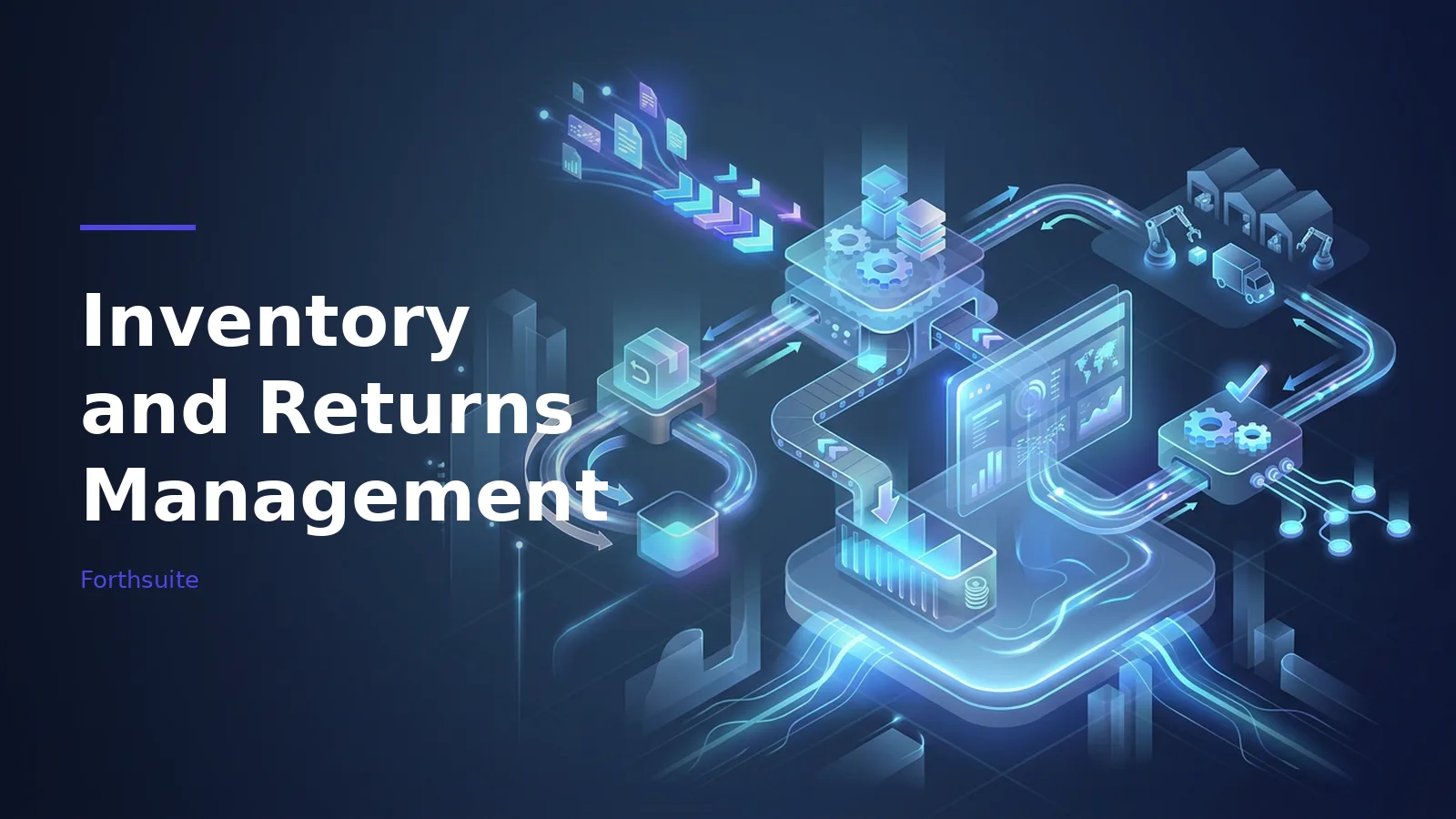
TL;DR: Integrating inventory and returns management on Shopify creates a unified system that reduces stock discrepancies, automates restocking workflows, and improves customer satisfaction by streamlining the entire product lifecycle. Forthsuite offers custom supply-chain builds that connect inventory tracking and returns processing for Shopify operators, reducing data silos across your store's backend systems.
Last updated: July 2026
Inventory and returns management for Shopify requires treating both processes as connected parts of a single system. When returns flow back into inventory accurately and demand forecasting accounts for return patterns, merchants can reduce stockouts and cut carrying costs. The key is automating the feedback loop between what customers send back and what you order next, rather than managing these functions separately.
Why Inventory and Returns Management Shopify Integration Matters
Most Shopify merchants treat inventory management and returns processing as separate workflows. You might use one system for tracking stock levels and purchase orders, and a completely different tool (or manual process) for handling returns.
This separation creates three expensive problems.
First, returned inventory often sits in a "returned" status for days or weeks before getting restocked. During that window, your inventory system shows those units as unavailable, even though they're perfectly sellable. For merchants with typical return rates, this represents hundreds of units in limbo at any given time.
Second, return patterns contain critical demand signals that never reach your purchasing decisions. If 40% of returned Medium t-shirts include a note saying "too small," that's actionable data. Customers are telling you they want Large. But when returns and inventory planning don't talk to each other, you keep ordering the wrong size mix.
Third, the financial impact compounds over time. A merchant doing $2 million annually with a typical return rate processes a substantial amount of returned merchandise. If even a fraction of those returns could inform better purchasing decisions, that's meaningful potential inventory optimization annually.
How Shopify Inventory Management Should Handle Returns
Standard Shopify inventory management updates stock levels when you process a return, but that's where most merchants stop. A proper integrated approach requires four additional layers.
“I don't know if I'm the right fit, just given the raw material side, but... it feels like a useful tool for someone who lives and runs their entire business out of Shopify.”
Set up location-specific return processing. When a return arrives at your warehouse, it shouldn't automatically go back to "available" status. Create a "Returns Inspection" location in Shopify where all returns land first. Items move to your main warehouse location only after inspection and any necessary repackaging. This prevents selling damaged goods and gives you accurate data on sellable return rates.
Track return reasons at the SKU level. Shopify's basic return reasons (wrong size, didn't like it, damaged) aren't granular enough. You need to know that your Navy Blue bomber jacket in size Large has a 22% return rate for "sleeves too long" while the Black version has only 6% returns. This data should live in your inventory system, not buried in customer service notes.
Calculate true available inventory. Your "available to sell" number should equal on-hand inventory minus pending shipments plus expected sellable returns. If you have 50 units in stock, 30 units in transit to customers, and historically 8 of those 30 will come back as sellable returns, your true available inventory is 28 units, not 50.
Build return timing into reorder points. Returns don't flow back evenly. Holiday purchases return in January. Summer inventory returns in September. Your reorder points need to account for these seasonal return patterns. If you typically see 300 units returned in January, your December reorder point should be 300 units higher than your formula would otherwise suggest.
Shopify Returns Management Best Practices for Inventory Accuracy
The returns process itself determines how well returned inventory flows back into your system. Poor returns management creates inventory inaccuracy that cascades through your entire operation.
Process returns within 48 hours of receipt. Every day a return sits unprocessed is a day that unit shows as out of stock in your system while taking up warehouse space. Merchants who process returns within two business days see fewer stockouts on returned SKUs compared to those taking 5-7 days. Use Forthroute to automate return authorization and create processing workflows that move returns through inspection faster.
Separate restocking from refunding. Many merchants refund customers immediately but restock inventory days later. This creates temporary inventory black holes. Set up a policy where inspection happens first, then refund and restock occur simultaneously. Your inventory accuracy improves and customers still get fast refunds (they care about refund speed, not whether it happens before or after you inspect the item).
Grade returned inventory by condition. Not all returns are equal. Create three inventory statuses: A-grade (like new, goes back to primary stock), B-grade (minor issues, sellable at discount), and C-grade (damaged, write off or liquidate). This prevents B and C grade items from being sold at full price and generating repeat returns.
Use variance reporting to catch shrinkage. Returns are high-shrinkage events. Items get misplaced, damaged during inspection, or stolen. Run weekly variance reports comparing expected returns (based on RMAs issued) versus actual inventory increases. If you issued RMAs for 100 units but only restocked 87, investigate immediately.
Connecting Return Patterns to Demand Forecasting
The most valuable aspect of integrated inventory and returns management is using return data to improve future purchasing decisions. This is where merchants see the biggest financial gains.
Return rates vary by product attribute. Return rates vary widely by category, with some product types returning at much higher rates than others. But within fashion, specific attributes drive returns: fit-related issues, color/material expectations, and quality concerns. When you track returns by these attributes, you can adjust purchasing accordingly.
For example, if your Relaxed Fit jeans have a 9% return rate but Slim Fit have 23% returns with 65% citing "too tight," that's a signal to either adjust your size chart, change manufacturers, or shift your buy mix toward Relaxed Fit. Use Forthcast to build return rate patterns into your demand forecasting model, automatically adjusting future purchase quantities based on historical return data.
Seasonal return timing affects cash flow. Products purchased in November often return in December and January. This creates a cash flow pattern where you're paying suppliers in October/November but receiving returns (and issuing refunds) in December/January. Factor this into your purchasing calendar by ordering 15-20% more for Q4 than your net demand requires, knowing returns will bring inventory back.
High-return products need different inventory strategies. If a product consistently shows 20%+ returns, don't just order more to compensate. Instead, order in smaller, more frequent batches. This lets you adjust based on real return data rather than committing to large purchases upfront. A merchant selling dresses might order 200 units of a new style instead of 500, then reorder based on actual return patterns from the first batch.
Automating the Inventory-Returns Feedback Loop
Manual integration between returns and inventory planning doesn't scale. Once you're processing more than 50 returns monthly, automation becomes necessary for accuracy.
Build automated return disposition rules. Set up rules that automatically assign returned items to A/B/C grade based on return reason and inspection notes. If return reason is "wrong size" and inspection notes include "tags attached, no wear," auto-assign to A-grade. If reason is "damaged" or inspection notes flag issues, route to manual review. This speeds processing and reduces errors.
Create return-adjusted safety stock calculations. Traditional safety stock formulas use standard deviation of demand. Enhanced formulas should include standard deviation of return rates. If your return rate for a product typically ranges from 8-14%, your safety stock needs to account for that 6-point variance. Products with volatile return rates need higher safety stock than products with stable returns, even if average demand is identical.
Set up return pattern alerts. Configure alerts when return rates spike above normal ranges. If a product's return rate jumps from 10% to 18% over two weeks, you need to know immediately. This might indicate a quality issue with a new batch, a marketplace listing problem, or a shipping damage pattern. Early detection prevents continued sales of problematic inventory.
Link return costs to inventory valuation. Returns cost money: shipping, inspection labor, repackaging, and liquidation of damaged goods. Track these costs per unit and include them in your inventory carrying cost calculations. A product with a 20% return rate and $8 average return processing cost has $1.60 in hidden costs per unit sold. This should inform pricing and inventory investment decisions.
Measuring Success in Integrated Inventory Returns Management
Track five metrics to know if your integrated approach is working.
Return-to-stock time measures days from return receipt to inventory availability. Best-in-class Shopify merchants average 1.8 days. If you're over 4 days, you're creating unnecessary stockouts. Break this metric down by product category since some items (electronics requiring testing) legitimately take longer than others (clothing requiring visual inspection).
Sellable return rate shows what percentage of returns go back into A-grade inventory. Industry average is 71%. If you're below 60%, investigate packaging, shipping methods, and product quality. Above 85% might mean you're being too lenient with what you restock (which can lead to selling damaged goods).
Return-adjusted forecast accuracy compares your demand forecast to actual net demand (sales minus returns). If you forecast 1,000 units, sell 1,000, but 150 come back, your net demand was 850. Your forecast should have predicted 850. Merchants using return-adjusted forecasting see a meaningful improvement in forecast accuracy compared to those ignoring return patterns.
Inventory turns by return rate segment helps identify problems. Calculate inventory turns separately for high-return products (above 15%) versus low-return products (below 8%). High-return products should turn faster because you're ordering more cautiously. If high-return products are turning slower, you're over-ordering despite knowing they'll come back.
Return reason resolution rate tracks how many return reasons you've actually addressed. If "too small" is your top return reason for six consecutive months but you haven't adjusted sizing, updated size charts, or modified purchasing, your integration isn't working. This metric should show monthly progress on eliminating repeat return causes.
Moving to an Integrated Operating System
True integration between inventory and returns management requires more than connecting two apps. It requires rethinking your supply chain as a continuous loop where returns inform purchasing, inventory levels determine return processing priorities, and both systems share a single source of truth.
Forthsuite provides this integrated approach for Shopify merchants. Forthcast brings AI-powered demand forecasting that automatically factors in return patterns, seasonal return timing, and product-specific return rates. Forthroute handles the returns management side with automated RMA processing, inspection workflows, and real-time inventory updates that feed directly back into your forecasting.
The combination eliminates the data gaps that create stockouts and overstock situations. When a return is processed in Forthroute, that data immediately updates inventory levels and informs the next Forthcast prediction. When Forthcast identifies a purchasing need, it accounts for expected returns in the timing and quantity recommendations.
Explore custom supply-chain builds at forthsuite.io to see how integrated inventory and returns management can reduce carrying costs while improving product availability for your Shopify store.
Frequently Asked Questions
How to integrate returns with inventory?
Set up a dedicated 'Returns Inspection' location in Shopify where all returns land first before moving to your main warehouse location after inspection. Track return reasons at the SKU level and calculate true available inventory by accounting for pending shipments and expected sellable returns. Process returns within 48 hours and ensure restocking happens simultaneously with refunding to avoid inventory black holes.
Inventory and Returns Management for Shopify?
TL;DR: Integrating inventory and returns management on Shopify creates a unified system that reduces stock discrepancies, automates restocking workflows, and improves customer satisfaction by streamlining the entire product lifecycle. Forthsuite's companion apps cover demand forecasting, sourcing, returns, 3PL monitoring and overstock liquidation for Shopify operators, working toward one end-to-end supply-chain stack.
About the Author

Hylke Reitsma is co-founder of Forthsuite and a supply chain specialist with 8+ years of hands-on experience at Shell, Verisure, and Stryker. He holds an MSc in Supply Chain Management from the University of Groningen and writes practical guides to help e-commerce teams run leaner, faster supply chains. Selected by Replit as 1 of 20 founders for the inaugural Race to Revenue Cohort #1 (2026) and certified as a Replit Platform Builder.
LinkedIn