Shopify Supply Chain Visibility Tools
Inventory visibility in supply chain: Discover essential tools and strategies for Shopify supply chain visibility in 2026.
Hylke Reitsma is co-founder of Forthsuite and a supply chain specialist with 8+ years of hands-on experience at Shell, Verisure, and Stryker. He holds an MSc in Supply Chain Management from the University of Groningen and writes practical guides to help e-commerce teams run leaner, faster supply chains. Selected by Replit as 1 of 20 founders for the inaugural Race to Revenue Cohort #1 (2026) and certified as a Replit Platform Builder.
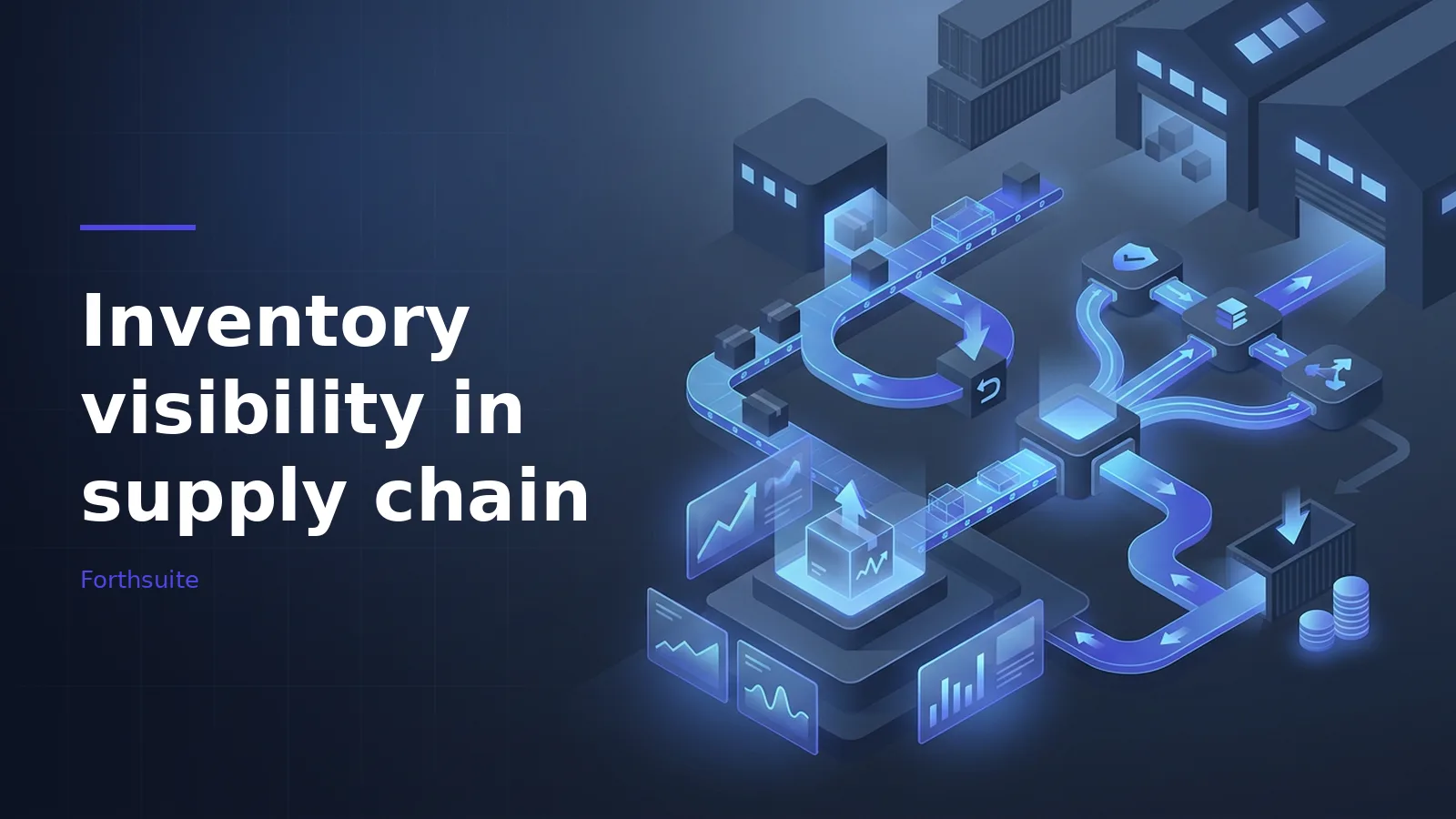
TL;DR: Shopify supply chain visibility in 2026 requires integrating real-time tracking tools, automated inventory management systems, and data analytics platforms that connect suppliers, warehouses, and shipping carriers into a unified dashboard. The Forthsuite app family helps Shopify operators build end-to-end supply chain visibility piece by piece — demand forecasting (Forthcast), returns (Forthroute), 3PL performance (Forthmatch), surplus liquidation (Forthclear), and supplier sourcing (Forthsource).
Shopify supply chain visibility means having real-time access to inventory levels, order status, supplier performance, and fulfillment metrics across your entire operation. The best approach combines native Shopify data with specialized tools for demand forecasting, 3PL tracking, and supplier management. Merchants who implement proper visibility systems reduce stockouts and cut carrying costs compared to those flying blind.
Why Shopify Supply Chain Visibility Matters More in 2026
Last updated: May 2026
The margin for error has never been smaller. Shopify merchants face higher supplier lead times than pre-2020 levels, according to recent industry data. Customer expectations have moved the other direction. Same-day and next-day delivery options now account for a growing share of online purchases, up sharply from a few years ago.
“I would definitely love something automated like we're in 2026. I can't believe I still have to do an export of my sales from Shopify, do an export of the stock the inventory at the 3PL.”
Without clear visibility into your supply chain, you're making decisions based on outdated information. Your Shopify dashboard shows what sold yesterday. It doesn't tell you that your bestselling item has a 12-week production delay in Vietnam, or that your 3PL's pick accuracy dropped to 94% last month.
The gap between what you think is happening and what's actually happening costs money. Merchants without proper tracking systems typically discover problems 3-4 weeks after they start. By then, you've already lost sales, paid for expedited shipping, or sitting on excess inventory you can't move.
Supply chain transparency on Shopify isn't about perfect information. It's about knowing enough, soon enough, to make better decisions than your competitors.
The Four Layers of Ecommerce Supply Chain Tracking
Effective visibility requires monitoring four distinct areas. Most merchants only track one or two, leaving blind spots that cause problems.
“There is currently no Shopify app that offers advanced COD (collecting a small upfront amount) or real-time RTO prevention.”
Demand Signal Monitoring
Your first layer is understanding what customers actually want. Shopify's sales reports show what already happened. You need forward-looking data. This means tracking search trends, cart abandonment patterns by product, email campaign engagement rates, and seasonal buying patterns from previous years.
The difference between reactive and predictive tracking is timing. If you wait until inventory hits your reorder point to place orders, you've already lost 2-6 weeks of lead time. Forthcast analyzes multiple demand signals to predict inventory needs 8-12 weeks out, giving you time to act before stockouts happen.
Supplier Performance Tracking
Your second layer monitors supplier reliability. Track on-time delivery percentage, quality defect rates, minimum order quantities, and actual lead times versus quoted lead times. The quoted lead time is marketing. The actual lead time is reality.
One apparel merchant we work with discovered their "4-6 week" supplier actually delivered in 7.2 weeks on average. That 2-week gap caused three stockouts over six months. Once they adjusted their planning to match reality, stockouts dropped to zero.
Document everything. How long from PO submission to production start? Production start to shipping? Shipping to port? Port to your warehouse? Most delays happen in the gaps between these stages, where nobody's clearly responsible.
Inventory Position Visibility
Your third layer tracks inventory across all locations. This includes stock in your warehouse, in transit from suppliers, at 3PLs, in Amazon FBA if you're multi-channel, and committed to unfulfilled orders.
Shopify's native inventory tracking handles the basics, but it doesn't show the complete picture. If you have 100 units "available" but 80 are allocated to a wholesale order shipping next week, your actual available-to-promise is 20 units.
Set up alerts at multiple thresholds. Don't just track "out of stock." Know when you hit 30 days of supply, 45 days, and 60 days. Different products need different buffers based on lead times and demand volatility.
Fulfillment Execution Monitoring
Your fourth layer measures how well orders actually ship. This includes pick accuracy, pack accuracy, shipping speed, carrier performance, and customer delivery experience.
If you use a 3PL, you're trusting them with your customer experience. Most 3PLs provide weekly or monthly reports. That's too slow. You need daily metrics at minimum. Forthmatch pulls real-time performance data from your Shopify orders to show 3PL speed and accuracy without waiting for their reports.
Building Your Shopify Supply Chain Visibility Stack
The right tool stack depends on your volume and complexity. A store doing $50,000 monthly needs different systems than one doing $2 million.
For Merchants Under $100K Monthly Revenue
Start with Shopify's built-in inventory tracking and reports. Add a simple spreadsheet to track supplier lead times and performance. Use Google Sheets with columns for PO date, expected delivery, actual delivery, and variance.
Set up Shopify's low stock alerts, but adjust the thresholds based on actual lead times, not defaults. If your supplier needs 6 weeks, set your alert at 8 weeks of inventory to account for variability.
Track your fulfillment speed manually at first. Export your orders weekly and calculate the gap between order date and ship date. If this gap trends upward, investigate immediately.
For Merchants at $100K-$500K Monthly
You need automated tracking at this level. Manual processes break down when you're shipping 50-150 orders daily.
Implement demand forecasting that considers trends beyond basic sales history. Your top 20 SKUs probably drive 70% of revenue. Get forecasting right on those products first. AI-powered demand forecasting can meaningfully reduce forecast error for most product categories.
Use inventory management software that integrates directly with Shopify and shows inventory in transit. Tools like Cin7, Skubana, or similar platforms connect your POs with your inventory counts.
If you work with a 3PL, get daily reporting or implement automated tracking that monitors their performance through your Shopify order data.
For Merchants Above $500K Monthly
At this volume, supply chain problems cost thousands of dollars per day. You need enterprise-grade visibility across all four layers.
Implement exception-based reporting. You don't need to review every metric daily. You need alerts when metrics fall outside acceptable ranges. Set thresholds and let the system notify you when supplier lead times spike, inventory falls below planned levels, or fulfillment speed drops.
Consider building custom dashboards that combine data from multiple sources. Your operations team needs different views than your finance team. Use tools like Google Data Studio, Tableau, or similar to pull data from Shopify, your 3PL, your suppliers (where possible), and your forecasting systems into unified views.
Evaluate supplier relationships quarterly using hard data. Track not just costs, but total landed cost including delays, quality issues, and communication overhead. A supplier charging 8% more but delivering consistently often costs less than a cheaper supplier who creates chaos.
Implementing Supply Chain Transparency Without Overwhelming Your Team
The biggest implementation mistake is trying to track everything at once. This creates dashboard fatigue where teams ignore reports because there's too much noise.
Start with your biggest pain point. If stockouts hurt most, focus on inventory visibility and demand forecasting first. If shipping delays cause the most customer complaints, prioritize fulfillment tracking.
Pick 5-7 key metrics to monitor weekly. For most Shopify merchants, this includes: inventory days on hand for top SKUs, forecast accuracy for the current month, supplier on-time delivery rate, average order processing time, and customer delivery time from order to doorstep.
Schedule a weekly 15-minute supply chain review. Same time, same day, same attendees. Review the metrics, identify exceptions, assign action items. Keep it short and focused.
Document your standard operating procedures as you go. When you discover a supplier is late, what's the process? Who contacts them? What information do you need? How do you communicate delays to customers? Write it down so anyone on the team can handle it.
Getting Suppliers to Share Information
Many suppliers resist sharing production schedules or detailed status updates. They're managing dozens or hundreds of customers and don't want to over-commit.
Make it easy for them. Instead of asking for daily updates, ask for milestone notifications. Tell them you need to know when: they receive your PO, production starts, production completes, and goods ship. Four simple notifications cover most of what you need.
Offer incentives for transparency. Some merchants provide slightly higher margins to suppliers who consistently hit communication and delivery standards. A 2-3% price premium is worth it if it eliminates stockouts.
For critical suppliers, consider paying for third-party verification. Services exist that will visit factories, verify production status, and conduct quality checks. This costs $200-500 per visit but provides certainty on important orders.
Using Inventory Visibility Tools to Prevent Common Problems
The point of visibility is preventing problems, not just documenting them. Here's how to turn data into action.
Preventing Stockouts
Stockouts happen because of three failures: demand spikes you didn't predict, supplier delays you didn't plan for, or reorder points set too low.
Address all three. Use demand forecasting that considers trends, seasonality, and marketing campaigns. Add buffer stock based on supplier reliability, not theoretical lead times. If a supplier quotes 4 weeks but averages 5.5 weeks, plan for 6 weeks.
Set dual reorder triggers. The first trigger at 60 days of inventory starts the conversation with suppliers and confirms lead times. The second trigger at 45 days places the actual order. This two-step approach catches supplier capacity issues before they become stockouts.
Reducing Excess Inventory
Excess inventory ties up cash and warehouse space. It happens when you over-order based on optimistic forecasts or can't adjust orders once placed.
Track inventory turn rates by product category. Fast fashion might turn 8-12 times per year. Furniture might turn 3-4 times. Know your targets and flag products falling behind.
Build flexibility into supplier agreements where possible. Some suppliers allow order quantity adjustments up to 2-4 weeks before shipping. Use this window to reduce orders for slower-moving items.
Improving Cash Flow
Visibility directly impacts cash flow by helping you order the right amount at the right time. Every dollar in excess inventory is a dollar not available for marketing or growth.
Calculate your cash conversion cycle. This measures days from when you pay suppliers to when customers pay you. The shorter this cycle, the less working capital you need. Most Shopify merchants run 45-90 day cycles depending on supplier payment terms and inventory turn rates.
Use your visibility data to negotiate better terms. If you can show a supplier consistent order patterns and reliable payment history, many will extend terms from 30 days to 45 or 60 days. An extra 30 days on $50,000 in monthly inventory purchases frees up $50,000 in working capital.
Measuring the ROI of Supply Chain Visibility Investments
Better visibility costs money, whether you're paying for software, staff time, or both. The investment should pay for itself through measurable improvements.
Track these metrics before and after implementing new visibility systems: stockout rate as a percentage of total SKUs, excess inventory as a percentage of total inventory value, average order fulfillment time, customer complaints related to shipping or availability, and emergency shipping costs.
A typical mid-size Shopify merchant ($300K-500K monthly revenue) implementing proper visibility tools sees: fewer stockouts, less excess inventory, lower expedited shipping costs, and faster average fulfillment time.
These improvements typically deliver strong ROI in the first year. A merchant spending $500 monthly on forecasting and tracking tools might save $1,500-2,500 monthly in reduced stockouts, lower carrying costs, and fewer rush orders.
The less tangible benefit is confidence. When you know what's happening across your supply chain, you can make commitments to customers, plan marketing campaigns, and make inventory decisions without the constant anxiety of operating blind.
Take Control of Your Shopify Supply Chain
Supply chain visibility transforms reactive merchants into proactive ones. Instead of discovering problems weeks late, you spot issues early enough to fix them.
Instead of guessing at reorder quantities, you base decisions on data.
Start small, measure results, and expand from there. Focus on the areas causing the most pain right now. Build systems that work for your team, not systems that look impressive but get ignored.
The Forthsuite app family provides the toolkit for Shopify supply chain management. Forthcast predicts demand before stockouts happen. Forthmatch monitors 3PL performance in real-time. Forthsource helps you find and verify reliable suppliers. Explore the complete suite at forthsuite.io and see how proper visibility can transform your operations.
How the Supply Chain Landscape Has Shifted in 2026
The most significant shift in Shopify supply chain management over the past 18 months has been the widespread adoption of real-time inventory synchronization across distributed networks. What was once a premium feature reserved for enterprise operations is now table stakes.
Mid-market brands running multiple warehouses or working with 3PL partners expect sub-15-minute inventory updates as standard, driven largely by the normalization of API-first warehouse management systems and the pressure to reduce overselling incidents during flash sales.
For B2B buyers and operations teams, this means legacy visibility tools that rely on end-of-day batch updates are creating measurable friction. Brands are increasingly evaluating partners based on their ability to provide granular, location-specific inventory data in real time. The cost of poor visibility has also increased: with tighter margins and higher customer acquisition costs, even a 2-3% oversell rate can materially impact profitability and customer lifetime value.
Looking ahead, watch for the convergence of inventory visibility and demand sensing. The next generation of tools will layer predictive stock-out alerts on top of real-time data, helping operators move inventory proactively rather than reactively. Teams that build this capability now will have a significant edge in the next 12-18 months.
Part of the Shopify Supply Chain Software guide. Related: Supply chain KPIs.
Frequently Asked Questions
How can I improve supply chain visibility for my Shopify store in 2026?
Improve Shopify supply chain visibility by implementing real-time tracking systems, integrating your inventory management with suppliers, and using specialized tools like Forthsuite. Focus on centralizing data from warehouses, carriers, and suppliers into one dashboard. Automate status updates, set up proactive alerts for delays, and establish clear communication channels with your logistics partners to maintain end-to-end transparency.
What tools do Shopify merchants use for supply chain visibility?
Shopify merchants use supply chain operating systems like Forthsuite to centralize visibility across their operations. Other essential tools include inventory management platforms, order tracking software, warehouse management systems, and carrier integration apps. The best solutions consolidate data from multiple sources, provide real-time updates, offer predictive analytics, and integrate seamlessly with Shopify's ecosystem to give merchants complete operational control.
Why is supply chain visibility important for Shopify businesses?
Supply chain visibility is crucial for Shopify businesses to meet customer expectations, reduce operational costs, and prevent stockouts. It enables proactive problem-solving by identifying delays before they impact customers, optimizes inventory levels to reduce holding costs, improves demand forecasting accuracy, and enhances customer satisfaction through accurate delivery estimates. Enhanced visibility also strengthens supplier relationships and supports data-driven decision-making.
What are the biggest supply chain visibility challenges for Shopify stores?
Shopify stores face challenges including fragmented data across multiple platforms, limited real-time tracking capabilities, poor supplier communication, and lack of integration between systems. Many merchants struggle with manual data entry, inconsistent information from different sources, difficulty scaling visibility as they grow, and inability to predict disruptions. Solutions like Forthsuite address these challenges by centralizing data and automating visibility workflows.
How does Forthsuite help with Shopify supply chain visibility?
Forthsuite serves as a comprehensive supply chain operating system specifically designed for Shopify merchants. It provides end-to-end visibility by integrating with suppliers, warehouses, and carriers in one centralized platform. The system offers real-time tracking, automated alerts, predictive analytics, and customizable dashboards that give merchants complete control over their supply chain operations, enabling faster decision-making and improved customer experiences.
Shopify Supply Chain Visibility: Tools and Strategies for 2026?
Shopify supply chain visibility in 2026 requires integrating real-time tracking tools, automated inventory management systems, and data analytics platforms that connect suppliers, warehouses, and shipping carriers into a unified dashboard. The Forthsuite app family helps Shopify operators build end-to-end supply chain visibility piece by piece — demand forecasting (Forthcast), returns (Forthroute), 3PL performance (Forthmatch), surplus liquidation (Forthclear), and supplier sourcing (Forthsource).
About the Author

Hylke Reitsma is co-founder of Forthsuite and a supply chain specialist with 8+ years of hands-on experience at Shell, Verisure, and Stryker. He holds an MSc in Supply Chain Management from the University of Groningen and writes practical guides to help e-commerce teams run leaner, faster supply chains. Selected by Replit as 1 of 20 founders for the inaugural Race to Revenue Cohort #1 (2026) and certified as a Replit Platform Builder.
LinkedIn