Supply Chain OS for Ecommerce
A supply chain OS for ecommerce centralizes inventory, orders, and fulfillment data in one platform. Learn how it streamlines operations for Shopify stores
Hylke Reitsma is co-founder of Forthsuite and a supply chain specialist with 8+ years of hands-on experience at Shell, Verisure, and Stryker. He holds an MSc in Supply Chain Management from the University of Groningen and writes practical guides to help e-commerce teams run leaner, faster supply chains. Selected by Replit as 1 of 20 founders for the inaugural Race to Revenue Cohort #1 (2026) and certified as a Replit Platform Builder.
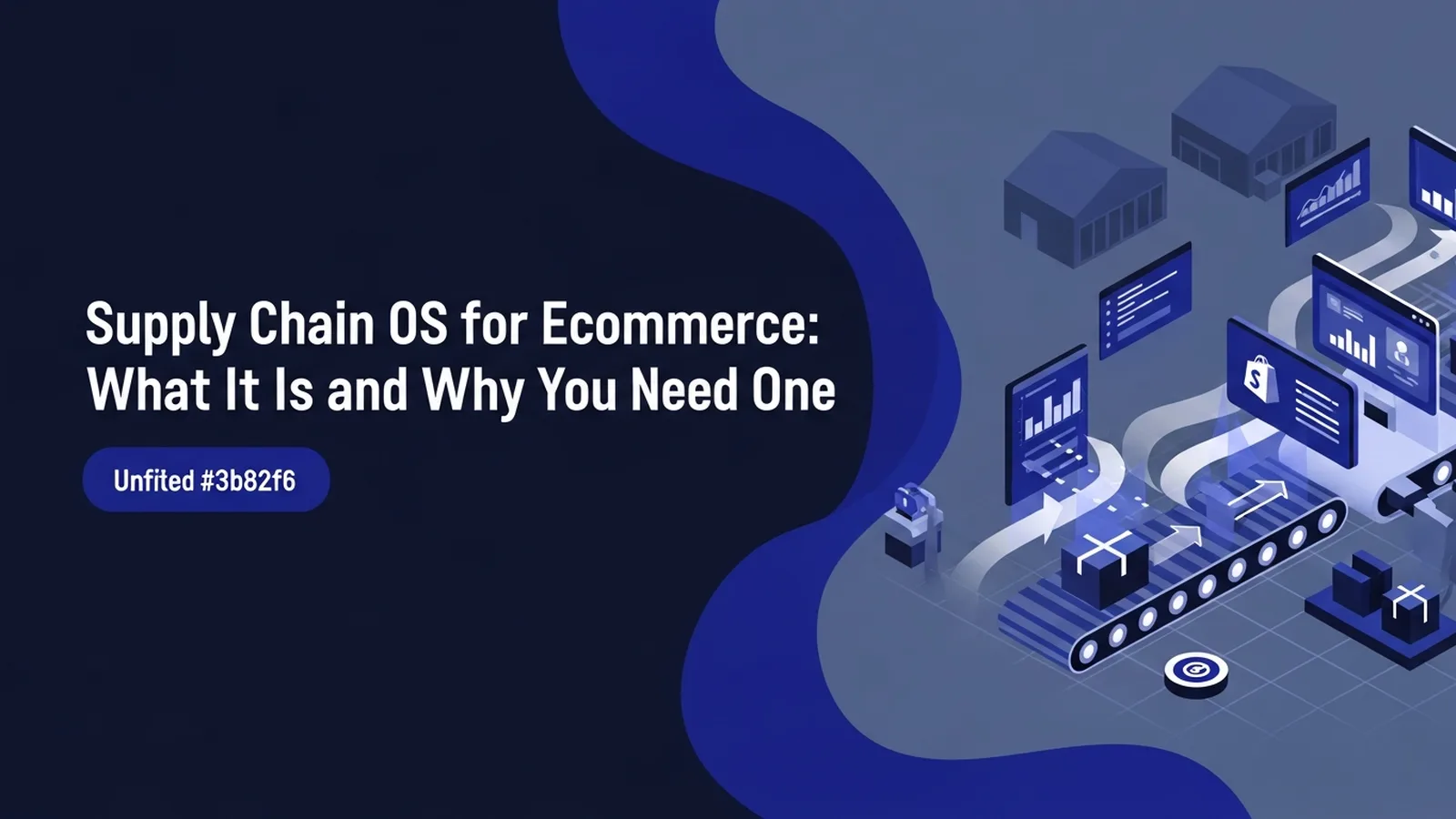
A supply chain OS for ecommerce is a unified software platform that connects inventory management, demand forecasting, warehouse operations, and logistics data into a single system. Instead of juggling separate tools for purchasing, shipping, returns, and 3PL coordination, you work from one source of truth that automates decisions and surfaces problems before they cost you money.
What Makes a Supply Chain Operating System Different from Traditional Software
Last updated: May 2026
Most ecommerce brands run their supply chains using a patchwork of tools: a Shopify app for inventory, spreadsheets for forecasting, email threads for supplier communication, separate portals for each 3PL partner, and manual tracking for returns. This fragmentation creates blind spots.
A supply chain operating system consolidates these functions. It's not just another point solution. The difference lies in integration depth and automation scope. Where traditional software handles one task, an operating system connects data across your entire operation and makes decisions automatically.
Here's what sets an OS apart:
- Unified data model: Your inventory levels, sales velocity, supplier lead times, and fulfillment metrics exist in one database. When a return comes in, the system instantly knows how it affects your available stock and reorder calculations.
- Cross-functional automation: Instead of manually transferring data between systems, workflows span departments. A stockout trigger can automatically generate a purchase order, alert your 3PL to expect inventory, and adjust marketing spend based on projected availability.
- Intelligent routing: The platform decides where orders ship from, which carriers to use, and when to route items through different warehouses based on cost, speed, and inventory position.
Traditional software requires you to be the connector. You export reports, compare numbers, and make decisions. A supply chain OS takes on that cognitive load, presenting exceptions and recommendations instead of raw data.
Core Components Every Ecommerce Supply Chain Platform Should Have
Not all platforms calling themselves operating systems actually function as one. Here are the non-negotiable components:
Demand Forecasting That Actually Works
Most Shopify merchants forecast using gut feel or simple moving averages. That breaks down when you have seasonal products, promotional spikes, or stockouts that suppress demand signals. A proper demand forecasting system uses machine learning to account for trends, seasonality, marketing calendar, and external factors.
Good forecasting should give you:
- SKU-level predictions at weekly granularity, not monthly averages
- Confidence intervals showing best and worst-case scenarios
- What-if modeling for promotions or new product launches
- Automatic updates as actual sales come in
When Forthcast generates your demand forecast, it immediately feeds that into purchasing recommendations and inventory alerts. You don't forecast in one tool and then manually translate that into action elsewhere.
Multi-Location Inventory Intelligence
If you're working with multiple warehouses or 3PLs, you need real-time visibility into where every unit sits. More importantly, you need the system to understand the implications of that distribution.
The platform should answer: Which location should fulfill this order? When should we transfer stock between facilities? Are we overstocked in the wrong place? What's our actual available-to-promise inventory after accounting for committed orders and safety stock?
3PL Performance Monitoring
Your 3PL sends you reports. Maybe they're accurate, maybe they're late, maybe they use metrics that don't match your internal definitions. An operating system pulls data directly from your fulfillment partners and measures what matters: ship time from order placement, error rates, damage rates, receiving speed, and cost per shipment.
Forthmatch connects to your 3PLs and tracks these metrics automatically. When a warehouse starts missing SLAs, you see it in your dashboard immediately, not two weeks later in a monthly report. This matters because a 3PL slipping on ship times can tank your conversion rate if customers see longer delivery estimates.
Returns Management That Closes the Loop
Returns are a data goldmine and a logistics headache. Most merchants treat them as an afterthought, but a supply chain OS treats returns as first-class citizens in your operation.
A returns management platform should:
- Automatically generate return labels and track packages
- Update inventory availability the moment items are inspected, not when they're reshelved
- Flag quality issues or serial returners
- Route damaged goods to liquidation or disposal workflows
- Feed return rate data back into product development
When a customer initiates a return through Forthroute, the system knows whether that item can go back to available stock, needs inspection, or should be diverted to surplus liquidation. That decision happens instantly, not after someone manually reviews the return.
Supplier and Sourcing Management
Your suppliers are the foundation of your supply chain, but most brands track supplier performance in spreadsheets or not at all. An operating system maintains a supplier database with lead times, minimum order quantities, defect rates, and communication history.
When you're scaling or launching new products, supplier sourcing tools help you find and vet manufacturers. The system should track which factories you've contacted, what quotes they've provided, and how current suppliers perform against those benchmarks. This prevents the common problem of staying with an underperforming supplier simply because changing feels too complex.
Why Spreadsheets and Point Solutions Eventually Break
Every fast-growing Shopify brand hits a wall where manual processes can't scale. Here's what that looks like:
You're doing $2 million annually. You manage 200 SKUs across 3 suppliers. You use a Shopify inventory app, email for POs, and a spreadsheet for forecasting. One person can keep this in their head.
Now you're doing $10 million. You have 800 SKUs, 12 suppliers, 2 warehouses, seasonal promotions, and 4 people touching supply chain decisions. Your spreadsheet is 47 tabs deep. Someone made a formula error three months ago and you didn't catch it until you were overstocked by $150,000. You spent two weeks reconciling inventory discrepancies between Shopify, your 3PL, and reality.
Point solutions don't solve this because they don't talk to each other. You might have great forecasting software, but it doesn't automatically adjust your reorder points in your inventory app. Your returns platform doesn't tell your forecasting tool that 30% of last month's sales came back. Your 3PL dashboard doesn't integrate with your accounting system.
The cognitive overhead becomes the bottleneck. Your team spends hours each week manually syncing data, generating reports that combine information from five systems, and making decisions based on stale information.
A supply chain operating system eliminates this friction by design. When everything runs on shared data and automated workflows, you scale operations without scaling headcount linearly.
ROI Metrics: What Improvement Actually Looks Like
Generic claims about "improved efficiency" don't mean much. Here are specific metrics that change when you implement a proper ecommerce supply chain platform:
Inventory turnover: Most Shopify brands turn inventory 4-6 times per year. With accurate forecasting and automated reordering, you should hit 8-12 turns. That's the difference between tying up $500,000 in inventory to support $3 million in annual sales versus only needing $250,000.
Stockout rate: If you're running out of your top 20% of SKUs more than twice per year, you're leaving money on the table. Each stockout costs you not just the immediate lost sales, but the suppression of future demand signals and potential customer churn. Proper demand forecasting typically helps cut stockout incidents.
Dead stock write-offs: Brands without systematic inventory management typically write off 8-15% of their inventory annually. With a connected system that flags slow-moving inventory early and routes it to surplus liquidation channels before it becomes worthless, you can reduce write-offs to 2-4%.
Time spent on supply chain admin: Track how many hours your team spends on PO creation, inventory reconciliation, 3PL communication, and report generation. A functional OS should cut this by 70%. If someone's spending 20 hours a week on this work, you're looking at recovering 14 hours for higher-value activities.
Order fulfillment cost: When you're routing orders intelligently and holding 3PLs accountable to SLAs, your per-order fulfillment cost should drop 12-20%. On a $5 million business shipping 50,000 orders annually, that's $30,000-$50,000 in direct savings.
How to Evaluate Supply Chain Software for Online Stores
Not every platform marketed as a supply chain OS actually functions as one. Here's how to separate real solutions from repackaged point solutions:
Ask About Data Integration
How does the platform connect to your existing systems? Real-time API integration is table stakes. If they're proposing CSV uploads or manual data entry, walk away. Ask specifically: How long after an order is placed does it appear in your system? How quickly does a return update available inventory?
Test the Automation Depth
Request a demo of a complete workflow. For example: "A customer orders a product that's in stock at warehouse A but low overall. Show me what happens automatically." The system should:
- Route the order to warehouse A
- Trigger a reorder alert because inventory fell below threshold
- Suggest a PO quantity based on forecast and lead time
- Update your cash flow projection based on the PO
If any of these steps require manual intervention, it's not fully integrated.
Examine the Reporting
You should be able to answer these questions in under 30 seconds: What's my current inventory value? Which SKUs are at risk of stockout in the next 30 days? What's my average 3PL ship time this month versus last month? What's my return rate by product category?
If generating these answers requires running multiple reports and combining data manually, the platform isn't doing its job.
Understand the Pricing Model
Many platforms charge per order, per SKU, or per user. These models can become expensive fast. Look for pricing that scales reasonably with your business. A platform that costs $500/month at $2 million in revenue should not cost $5,000/month at $5 million in revenue unless the value scales proportionally.
Building Your Supply Chain OS Stack
Forthsuite offers custom supply-chain builds that draw on the Forth family of apps — Forthcast, Forthroute, Forthmatch, Forthclear, and Forthsource. Instead of stitching together five different vendors yourself, a Forthsuite engagement designs and builds a connected setup around the parts of your operation that need it.
The platform includes AI-powered demand forecasting that feeds directly into automated purchasing recommendations, 3PL performance tracking that holds your fulfillment partners accountable, returns management that closes the loop on inventory, surplus liquidation tools that recover value from slow-moving stock, and supplier sourcing that helps you find and verify manufacturers.
Everything runs on a unified data model. When a return comes in, your available inventory updates instantly. When a forecast changes, your reorder points adjust automatically. When a 3PL misses their ship time SLA, you see it in real-time, not in next month's report.
If you're running a seven-figure Shopify store and your supply chain still runs on spreadsheets and gut feel, explore what a custom supply-chain build can do for your business at forthsuite.io.
How the Supply Chain Landscape Has Shifted in 2026
The biggest change in 2026 is the normalization of AI-powered control towers across mid-market operations. What was once exclusive to enterprise supply chains is now table stakes for ecommerce brands moving $10M+ annually.
Real-time visibility isn't a differentiator anymore—it's the baseline expectation from retail partners and end customers alike.
This shift matters because fragmented systems are now a competitive liability, not just an operational headache. B2B buyers are demanding sub-24-hour order-to-ship windows, and brands running on disconnected warehouse, inventory, and fulfillment tools are losing contracts to competitors with unified operating systems. The penalty for manual reconciliation and delayed data has moved from "inefficient" to "business-ending."
Looking ahead, watch how carbon accounting gets baked into supply chain platforms by Q4 2026. Early regulations in the EU are pushing brands to track Scope 3 emissions at the SKU level, and that requirement will cascade to North American operations faster than most operators expect. The question isn't whether your stack can handle compliance reporting—it's whether you'll have six months or six weeks to implement it when mandates arrive.
Frequently Asked Questions
What is a supply chain OS for ecommerce?
A supply chain OS for ecommerce is a centralized platform that manages all supply chain operations in one place. It connects inventory management, order fulfillment, supplier coordination, and logistics tracking into a unified system. For Shopify merchants, platforms like Forthsuite provide real-time visibility and automation to streamline operations, reduce errors, and improve efficiency across the entire supply chain workflow.
Why do Shopify stores need a supply chain operating system?
Shopify stores need a supply chain OS to eliminate manual processes and disconnected tools that cause fulfillment delays and inventory issues. As ecommerce businesses scale, managing suppliers, warehouses, and orders becomes increasingly complex. A supply chain operating system automates workflows, provides real-time data, and prevents stockouts, helping merchants deliver better customer experiences while reducing operational costs.
How does a supply chain OS improve ecommerce operations?
A supply chain OS improves ecommerce operations by centralizing data and automating repetitive tasks. It provides real-time inventory visibility, automates purchase orders, streamlines supplier communication, and syncs order fulfillment across channels. This reduces human error, speeds up delivery times, and enables better decision-making through analytics. Merchants can focus on growth instead of managing spreadsheets and multiple disconnected systems.
What features should I look for in a supply chain OS for my online store?
Essential features include real-time inventory tracking, automated purchase order generation, supplier management tools, multi-warehouse coordination, and seamless integration with your ecommerce platform. Look for solutions offering demand forecasting, shipment tracking, and customizable workflows. For Shopify merchants, native integration is crucial. Forthsuite provides these capabilities specifically designed for ecommerce businesses, ensuring smooth operations and scalability.
Is Forthsuite worth it for small ecommerce businesses?
Yes, Forthsuite is valuable for small ecommerce businesses planning to scale. While startups with minimal SKUs might manage manually, growing businesses quickly face inventory chaos and fulfillment challenges. Implementing a supply chain OS early prevents costly mistakes, saves time on manual tasks, and builds a foundation for sustainable growth. Forthsuite's Shopify-native design makes it accessible and scalable for businesses at various stages.
About the Author

Hylke Reitsma is co-founder of Forthsuite and a supply chain specialist with 8+ years of hands-on experience at Shell, Verisure, and Stryker. He holds an MSc in Supply Chain Management from the University of Groningen and writes practical guides to help e-commerce teams run leaner, faster supply chains. Selected by Replit as 1 of 20 founders for the inaugural Race to Revenue Cohort #1 (2026) and certified as a Replit Platform Builder.
LinkedIn